
In commercial automotive collision repair, marine vessel recoating, and industrial surface finishing, chemical consistency is non-negotiable. Modern multi-stage coating systems—including high-solid polyurethane clear coats, waterborne metallic basecoats, and fast-acting isocyanate activators—rely on aggressive organic solvents to maintain viscosity and flow prior to atomization. When these reactive chemicals come into contact with disposable preparation containers, the underlying polymer composition of the cup directly impacts coating purity. While some low-cost suppliers utilize reprocessed or blended industrial resins to reduce unit manufacturing costs, experienced procurement managers and paint shop directors recognize that inferior plastics introduce severe operational risks.
Evaluating the material science behind a commercial Paint Spray System is essential for distributors and collision repair networks aiming to eliminate clear coat defects, solvent leaching, and structural failures on the shop floor.
1. Chemical Inertness and the Risk of Plasticizer Leaching
Recycled polypropylene (PP) and low-grade polyethylene blends frequently contain residual trace contaminants, processing stabilizers, and slip agents carried over from previous industrial molding cycles. When exposed to aggressive aromatic solvents such as xylene, toluene, methyl ethyl ketone (MEK), or lacquer thinners, non-virgin polymers begin to swell and soften at the microscopic level.
This chemical instability triggers two costly failure modes in commercial paint booths:
-
Silicone and Plasticizer Contamination: Solvents extract trace oils and plasticizers from the inner walls of low-grade paint cups, transferring them directly into the mixed clear coat or basecoat. Once sprayed onto a prepared automotive panel, these microscopic contaminants cause severe surface tension disruptions—commonly known as “fisheyes” or cratering—forcing technicians to strip and repaint entire panels.
-
Structural Wall Deformation: As recycled polymers absorb solvent vapors during mixing and agitation, the cup walls lose dimensional rigidity. In calibrated measuring vessels, wall flexing distorts volumetric graduation lines, leading to inaccurate hardener-to-paint ratios that compromise curing times and final gloss retention.
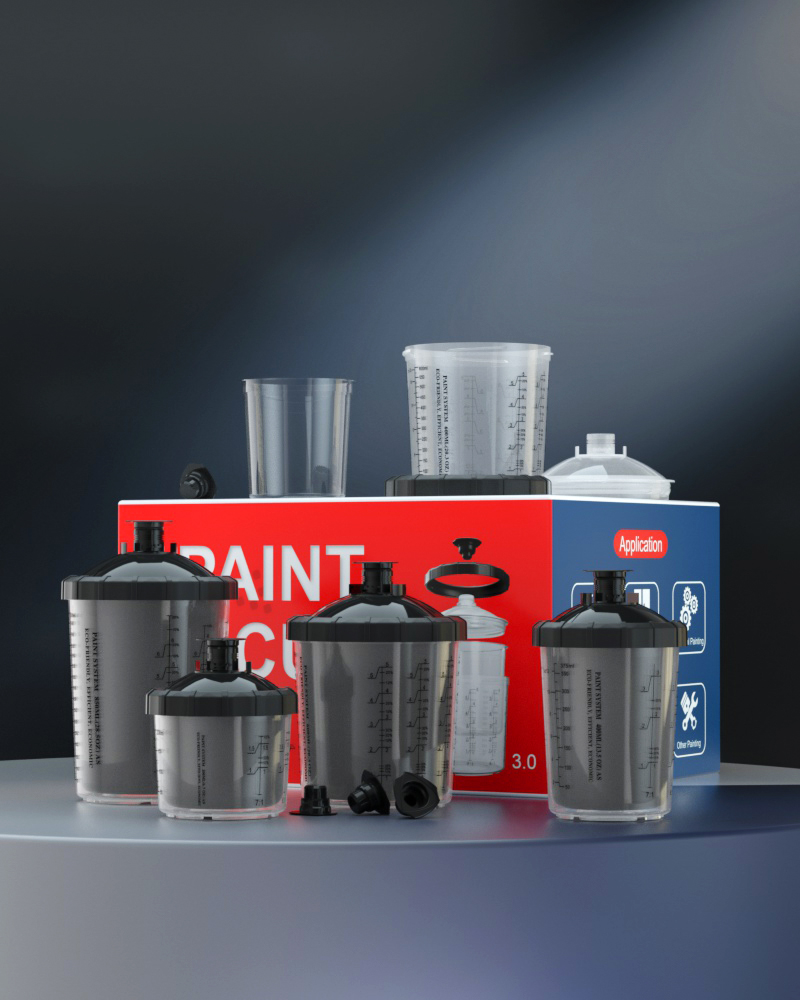
2. Engineering Standards of 100% Virgin Polypropylene
To guarantee zero chemical interference across all solvent-borne and waterborne paint formulations, QINGDAO AOSHENG PLASTIC CO., LTD manufactures its entire range of disposable liners, calibrated mixing cups, and rigid outer support sleeves exclusively from 100% virgin, automotive-grade polypropylene (PP).
Virgin PP provides distinct technical advantages for high-volume spray operations:
-
Complete Solvent Resistance: The uniform crystalline structure of virgin polypropylene resists chemical attack from harsh reducers, gun wash thinners, and catalyzed primers without softening, cracking, or releasing extractables.
-
Superior Optical Clarity: Unlike recycled resins that exhibit a cloudy, yellowish tint, virgin PP offers exceptional optical transparency. Mixing technicians can clearly read fluid meniscuses against external ratio graduations from any viewing angle, eliminating parallax errors during precise chemical proportioning.
-
Ultrasonic Weld Integrity: High-purity polypropylene melts uniformly during ultrasonic assembly, ensuring that integrated micron mesh filters (125-micron and 190-micron) bond permanently to disposable lids without adhesive glues that could dissolve in paint solvents.
3. Vacuum Collapse Reliability in a Closed Paint Spray Cup
Beyond chemical purity, mechanical elasticity plays a decisive role in fluid delivery. In a vacuum-driven paint spray cup system, the flexible inner liner must collapse smoothly and evenly under atmospheric pressure as coating material exits the fluid nozzle.
Liners extruded or thermoformed from inconsistent recycled blends often develop uneven wall thicknesses or brittle stress points. During spraying, brittle liners can crease abruptly, trap air pockets, or pinhole leak, resulting in fluid sputtering and inconsistent fan patterns. Virgin polypropylene liners engineered with controlled wall-thickness tolerances collapse predictably from top to bottom, sustaining uninterrupted fluid delivery even when spraying at inverted 180-degree angles under vehicle rocker panels and chassis frames.
4. Volumetric Scale Durability and Solvent-Proof Printing
A mixing cup is only as reliable as its printed measurement graduations. During daily prep-station workflows, exterior cup surfaces are frequently wiped down with solvent-dampened cloths or exposed to accidental paint drips. Standard screen-printing inks rapidly smear or dissolve upon solvent contact, rendering ratio scales unreadable.
Our manufacturing process utilizes specialized, chemically cross-linked printing inks formulated to bond permanently to virgin PP surfaces. Standard industry mixing ratios—including 2:1, 3:1, 4:1, 5:1, and 10:1 scales alongside milliliter and fluid ounce graduations—remain sharp and legible throughout extended workshop use.
5. Factory-Direct Quality Control with QINGDAO AOSHENG PLASTIC CO., LTD
For international paint distributors, regional wholesalers, and private-label brand owners, consistent resin traceability protects brand reputation and minimizes customer defect claims. QINGDAO AOSHENG PLASTIC CO., LTD operates automated, clean-environment injection molding and thermoforming facilities with strict raw material batch verification.
We enforce incoming resin certification checks, automated optical inspection for wall uniformity, and leak-testing protocols across every production run. By partnering directly with QINGDAO AOSHENG PLASTIC CO., LTD, global buyers secure certified virgin-resin quality, reinforced maritime export packaging, and competitive factory-direct wholesale pricing structures.
Contact our international commercial export team today to request technical resin data sheets, free product sample kits, and volume-based quotation schedules.
Post time: Nov-13-2026