
Material waste and surface contamination represent the two largest sources of financial loss in automotive collision repair and commercial marine vessel recoating. The vehicle preparation phase—encompassing precise volumetric chemical blending and extensive surface masking—consumes up to 70% of a technician’s total labor hours per job. Inaccurate mixing ratios directly cause slow curing, gloss loss, or poor adhesion, while inadequate surface shielding allows overspray to drift onto unpainted panels, forcing technicians to spend unbilled labor hours on corrective compounding and buffing.
Implementing a standardized preparation protocol utilizing commercial-grade calibrated containers alongside high-performance masking barriers provides an industrial solution for lowering chemical overhead and maximizing daily booth capacity.
Procurement Strategy: Sourcing the Right Wholesale Plastic Cup Inventory
Modern multi-stage automotive paint systems require strict adherence to chemical mixing ratios specified by coating manufacturers. Mixing activators, reducers, and base materials by approximation or using non-calibrated containers increases the margin for error, resulting in finish inconsistencies that demand costly panel stripping and repainting.
For distributors and purchasing managers, securing a certified Wholesale Plastic Cup supply guarantees operational consistency across body shop networks:
-
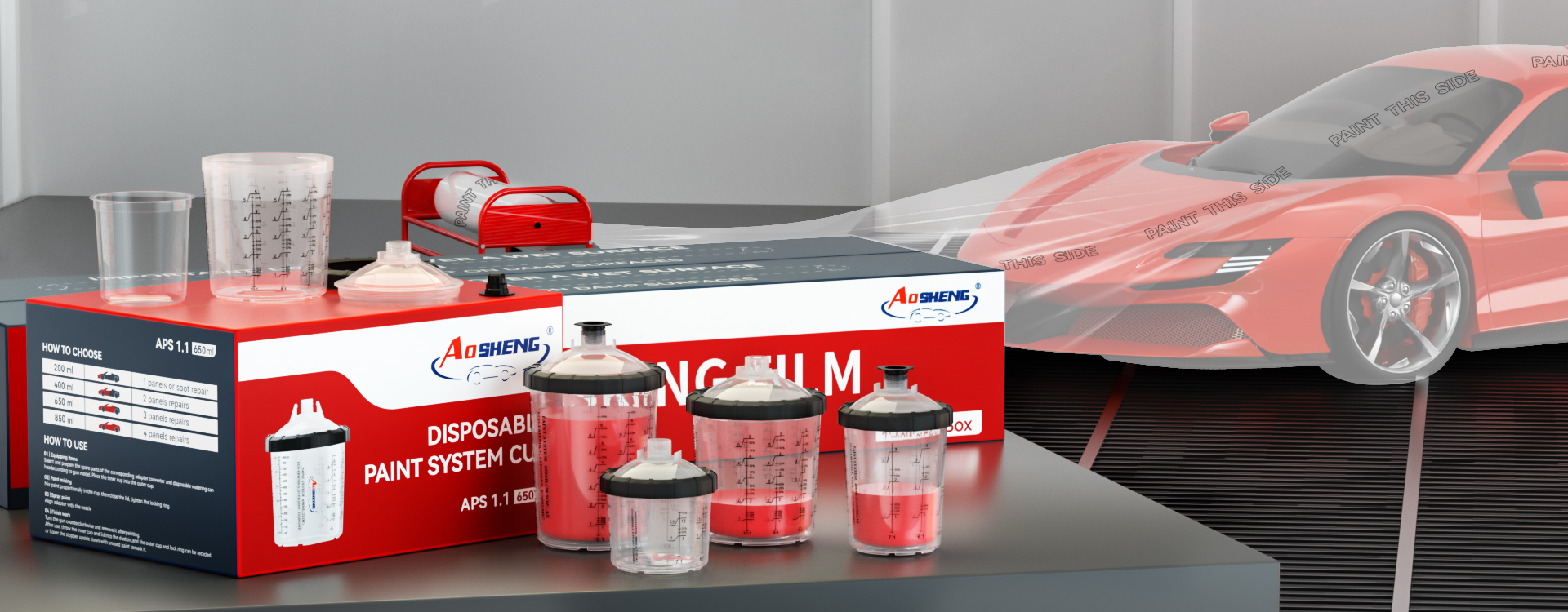
Chemical-Resistant Polypropylene Construction: Manufactured from high-density virgin polypropylene (PP), these containers resist aggressive chemical thinners, hardeners, and polyurethane topcoats without warping, cracking, or leaching plasticizers into the coating mixture.
-
Solvent-Bonded Graduations: Each container features solvent-resistant external graduation markings detailing standard industry mixing ratios (such as 2:1, 3:1, 4:1, 5:1, and 10:1) alongside milliliter and fluid ounce metrics, ensuring exact chemical proportions during rapid workshop cycles.
-
Stackable High-Density Storage: The tapered geometric design allows high-density nesting, reducing warehouse storage footprints and optimizing maritime freight container utilization for international importers.
Liquid Handling Economics via a Wholesale Spray Paint Cup Product
Beyond measuring containers, integrating an engineered Wholesale Spray Paint Cup Product directly onto the paint line eliminates fluid retention waste. Traditional preparation models involve mixing components in one vessel, straining into a second container, and pouring into a metal spray reservoir. Every physical transfer leaves residual coating material on the walls of discarded containers, generating significant cumulative financial loss over a fiscal year.
Consolidating these steps into a closed disposable liner framework provides clear cost-saving benefits:
-
Elimination of Intermediate Fluid Retention: Technicians measure, mix, strain, and spray within the same container assembly, cutting fluid loss by up to 15%.
-
Airtight Material Preservation: If a job requires less paint than mixed, technicians can insert airtight sealing plugs into the lid, safely preserving unspent coatings inside the liner for future panel blending.
-
Reduced Gun-Washing Overhead: Eliminating the need to wash metal reservoirs reduces cleaning thinner consumption by up to 70%, lowering hazardous waste disposal costs and improving workshop VOC compliance.
Advanced Overspray Defense with a Disposable Paint Masking Film Product
While fluid delivery systems safeguard coating materials from within the gun, external panels, glass, and interior cabin surfaces must be shielded from overspray mist and clear coat drift. Traditional masking paper rolls are heavy, slow to position, and prone to shedding paper fibers inside clean rooms or allowing solvent bleed-through when heavily saturated.
Deploying a commercial-grade disposable Paint Masking Film Product provides measurable technical advantages over standard masking materials:
-
Engineered Corona Surface Treatment: Untreated plastic sheeting allows paint overspray to bead up, dry during bake cycles, and subsequently flake off onto wet vehicle panels when disturbed. Our high-density polyethylene (HDPE) masking films undergo an electronic corona discharge treatment during extrusion. This alters the polymer’s surface energy, forcing paint mist, primer drift, and clear coat overspray to bond permanently to the film surface.
-
Static Cling for Single-Operator Handling: Engineered with an inherent electrostatic charge, the film clings tightly to vehicle contours, body lines, and glass upon deployment. A single operator can cover an entire passenger vehicle or commercial van in minutes, drastically reducing prep labor hours.
-
Thermal and Solvent Resistance: Formulated to withstand standard infrared drying lamps and spray booth bake cycles (up to 110°C / 230°F) without degradation, these films prevent solvent penetration and leave zero adhesive ghosting or synthetic residue upon removal.
Consolidating Global Supply Chains with QINGDAO AOSHENG PLASTIC CO., LTD
QINGDAO AOSHENG PLASTIC CO., LTD specializes in manufacturing large-scale commercial orders of surface preparation and paint booth consumables for global distribution channels. Our production facilities operate under strict quality management frameworks to ensure high tensile film strength, uniform corona treatment levels, and precise container dimensions across every batch.
We support international paint wholesalers, brand owners, and regional industrial suppliers by offering direct factory commercial terms, reinforced export packaging built for ocean shipping, and dependable lead times to ensure local supply chain continuity.
Partner with an experienced global manufacturer. Contact the commercial engineering division at QINGDAO AOSHENG PLASTIC CO., LTD today to request free product samples, comprehensive catalogs, and volume-based factory quotation schedules.
Post time: Sep-21-2026