
In commercial automotive collision centers and specialized fleet refinishing facilities, managing cycle times inside the spray booth is critical to controlling operating overhead. Liquid coatings, activators, and thinners represent significant ongoing expenditures, but labor-intensive manual mixing and repetitive equipment washing frequently introduce severe production bottlenecks. Traditional gravity-fed spraying setups rely on rigid aluminum or stainless-steel fluid reservoirs with open top vents. These legacy configurations demand extensive manual cleaning with aggressive chemical solvents after every coat, creating high labor costs and increasing hazardous chemical disposal liabilities.
To systematically eliminate these operational bottlenecks, commercial refinishing networks and regional paint distributors are standardizing their facilities around integrated single-use fluid architectures that streamline chemical preparation and fluid delivery.
Fluid Dynamics and Inverted Spraying with an Advanced PPS Cup System
Transitioning from traditional vented reservoirs to a sealed pps cup fundamentally alters the physics of fluid delivery inside the spray booth. Legacy gravity-fed cups depend on atmospheric venting and gravitational pull to draw paint into the fluid nozzle. This design limits the spray gun’s operational range and creates a vulnerability where airborne shop dust can settle into the coating mixture through the vent hole.
A vacuum-sealed liner framework resolves these mechanical challenges through predictable atmospheric compression:
-
True 360-Degree Omnidirectional Spraying: As paint is discharged through the nozzle, atmospheric pressure acts evenly against the flexible inner liner, causing it to collapse predictably. Because fluid delivery relies on a continuous vacuum seal rather than gravitational pull, the system functions reliably at any physical angle—including complete 180-degree inverted positions. Technicians can coat low vehicle rocker panels, intricate wheel arches, and chassis undercarriages smoothly without experiencing paint starvation, pressure drops, or fluid sputtering.
-
Absolute Isolation from Airborne Debris: Operating as a completely closed fluid pathway prevents shop dust, lint, and dry overspray from entering the paint reservoir during application. This reduces surface clear coat imperfections, significantly decreasing post-bake color sanding and corrective polishing hours.
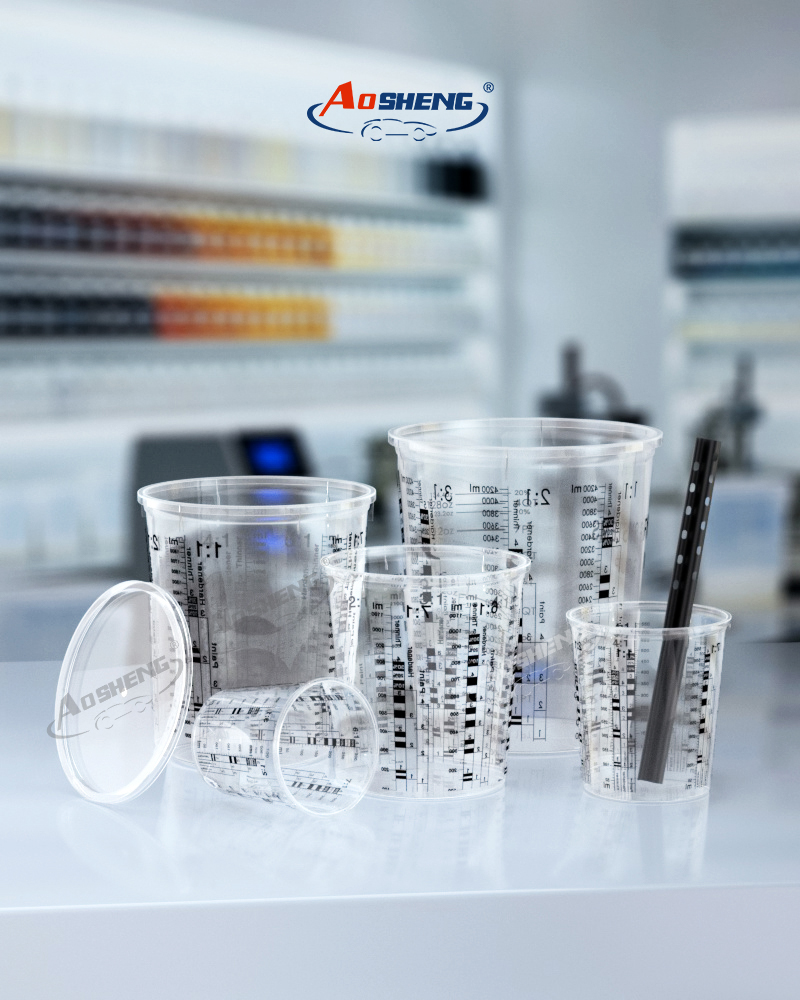
Process Standardization Using a Calibrated Mixing Paint Cup
Achieving predictable drying times, long-term gloss retention, and durable chemical cross-linking in automotive clear coats requires strict adherence to paint manufacturer volumetric blending ratios. Inaccurate mixing ratios compromise coating integrity, leading to soft finishes, cloudiness, or premature peeling that requires expensive rework.
Utilizing a dedicated mixing paint cup stabilizes the preparation process:
-
Permanent Solvent-Resistant Scales: Our industrial mixing containers feature high-contrast external markings detailing standard industry blending ratios (including 2:1, 3:1, 4:1, 5:1, and 10:1 scales) alongside exact milliliter metrics. These scales are chemically bonded to the plastic to resist degradation when exposed to aggressive cleaning solvents and thinners.
-
Dimensional Wall Rigidity: Manufactured from premium, high-transparency virgin polypropylene (PP), these containers resist wall flex during mechanical stirring, ensuring that volumetric liquid levels remain true to scale. High optical clarity allows mixing technicians to verify fluid heights accurately from any angle.
Enhancing Efficiency in Professional Spray Gun Painting Car Applications
During high-intensity spray gun painting car operations, throughput depends on eliminating unnecessary transfers and cleaning cycles. Consolidating the measuring, blending, straining, and spraying stages into a single synchronized container assembly yields measurable operational savings for high-volume body shops:
-
Zero Transfer Waste: Traditional multi-vessel transfers leave residual paint coating the walls of each container. Closed single-unit systems eliminate intermediate transfer loss, reducing cumulative paint retention waste by up to 15% per mix.
-
Solvent Overhead Reduction: Eliminating rigid aluminum cup washing reduces thinner consumption for gun cleaning by up to 70%, lowering solvent procurement costs and reducing environmental disposal compliance fees.
-
Preservation of Leftover Chemistry: Sealing plugs inserted directly into the cup lid allow unspent basecoats or clear coats to be saved safely inside the liner for subsequent panel touch-ups, preventing the immediate disposal of expensive coatings.
-
Integrated Micro-Filtration: Lids feature built-in mesh strainers (125-micron for basecoats and 190-micron for primers and clear coats) chemically bonded into the fluid outlet. This forces every milliliter of paint through a fresh filter immediately prior to atomization, bypassing external paper strainers and accelerating prep time.
Global Distribution Supply with QINGDAO AOSHENG PLASTIC CO., LTD
For international paint wholesalers, regional refinish distributors, and industrial buying groups, maintaining inventory stability is critical to avoiding downtime across local collision networks. QINGDAO AOSHENG PLASTIC CO., LTD operates automated, large-scale manufacturing facilities specialized in producing export-grade surface preparation consumables and spraying supply systems.
Our factory maintains strict dimensional tolerances, permanent chemical-resistant graduate printing, and heavy-duty export packaging designed to withstand ocean freight shipping and stacked warehouse logistics. By establishing direct factory partnerships, global buyers secure reliable product consistency, guaranteed production lead times, and competitive wholesale pricing structures necessary to maintain strong local market margins.
Contact our international commercial export team today to request complete compatibility charts, physical product specification sheets, and volume-based factory direct quotation schedules.
Post time: Sep-20-2026